Waffle House Small Restaurant Business Plan USA Setup Complete 2026 Guide
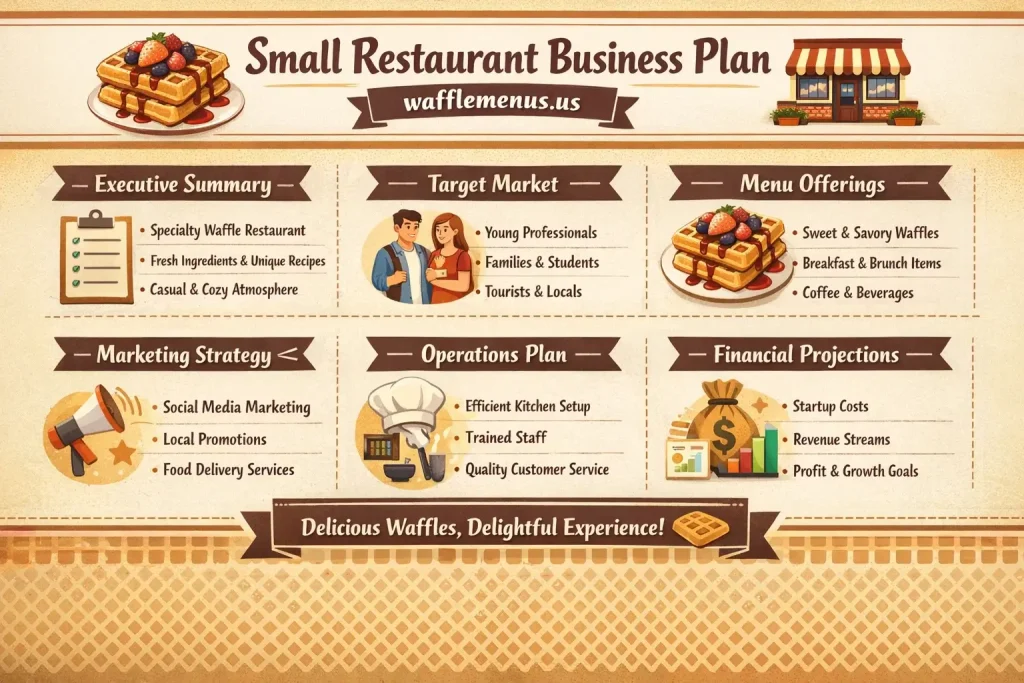
Want to open a small restaurant in the USA but don’t know where to start? A solid business plan is your first and most important step toward success. Opening a restaurant is one of the most exciting yet challenging business ventures you can undertake. The restaurant industry in the United States generates over $1 trillion in annual sales, with over 1 million restaurant locations nationwide.
However, nearly 60% of restaurants fail within their first year, and 80% close within five years. The difference between success and failure often comes down to one thing: a well-researched, comprehensive business plan. From my experience researching the food service industry and studying successful restaurant models like Waffle House, a strong business plan helps you secure funding, guide your operations, and avoid common pitfalls.
Whether you’re planning a small diner, a coffee shop, a food truck, or a fast-casual restaurant, this guide will walk you through every section of a winning business plan. For a complete overview of successful restaurant operations, visit our Waffle House menu with prices homepage at https://wafflemenus.us/
How to Setup Small Restaurant Business Plan USA
The executive summary is the most important part of your business plan. It’s the first thing investors and lenders will read, and it should convince them to keep reading.
What to Include in Your Executive Summary
| Section | Description |
|---|---|
| Business Concept | What type of restaurant? (diner, fast-casual, food truck, etc.) |
| Mission Statement | Your purpose and values |
| Target Market | Who are your customers? |
| Unique Selling Proposition | What makes you different from competitors? |
| Financial Highlights | Startup costs, projected revenue, break-even point |
| Funding Request | How much money do you need? |
Sample Executive Summary
“Small Plate Diner is a proposed 50-seat fast-casual restaurant located in downtown Austin, Texas, specializing in affordable breakfast and lunch served 24/7. Our mission is to provide high-quality, made-to-order comfort food at prices accessible to all. Targeting young professionals, late-night workers, and families, we differentiate ourselves through our open kitchen concept, customizable menu, and 24/7 operation. We project first-year revenue of $850,000 with a break-even point at month 8. We are seeking $250,000 in startup funding to cover equipment, leasehold improvements, and initial working capital.”
For a real-world example of successful 24/7 restaurant operations, check out the Waffle House hours and Waffle House locations guides.
Top Waffle House Small Restaurant Business Plan USA Company Description
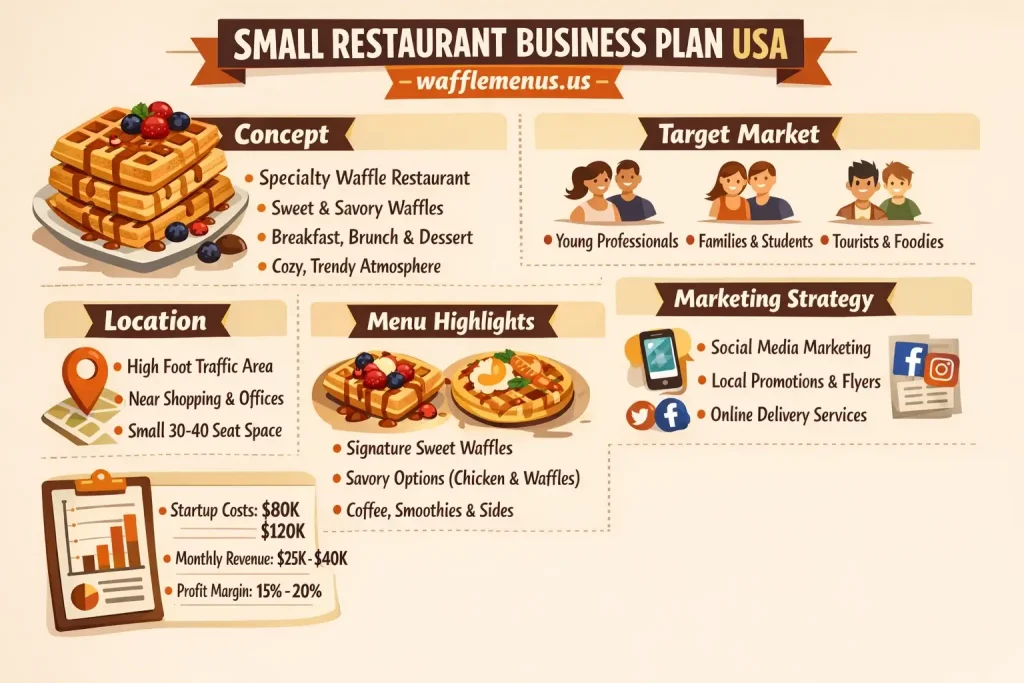
This section provides detailed information about your restaurant concept, legal structure, and location.
Key Elements of Company Description
| Element | Details to Include |
|---|---|
| Legal Structure | Sole proprietorship, LLC, partnership, or corporation |
| Business Location | Address, square footage, lease terms |
| Concept Type | Diner, coffee shop, food truck, fast-casual, full-service |
| Hours of Operation | Days and hours you plan to be open |
| Years in Business | Startup or existing business |
Restaurant Legal Structure Options
| Structure | Best For | Pros | Cons |
|---|---|---|---|
| Sole Proprietorship | Single owner, low risk | Simple, low cost | Unlimited personal liability |
| LLC | Most small restaurants | Personal liability protection, tax flexibility | Higher setup cost |
| Partnership | Multiple owners | Shared resources | Potential conflicts |
| Corporation (S-Corp/C-Corp) | Large operations | Best liability protection | Complex, expensive |
For a successful restaurant model, study Waffle House franchise cost and operational structure.
Restaurant Market Analysis
Understanding your market is critical. This section proves there’s demand for your restaurant.
Market Analysis Components
| Component | What to Research |
|---|---|
| Industry Overview | Restaurant industry trends, growth projections |
| Target Market Demographics | Age, income, location, lifestyle of ideal customers |
| Market Size | Number of potential customers in your area |
| Competitor Analysis | Strengths and weaknesses of nearby restaurants |
| Market Trends | Current food and dining trends |
2026 Restaurant Industry Trends
| Trend | Impact on Small Restaurants |
|---|---|
| 24/7 Dining Demand | Growing demand for late-night food options |
| Delivery Integration | Must offer third-party delivery |
| Healthy Options | Customers want gluten-free, keto, vegan choices |
| Open Kitchens | Transparency builds trust |
| Value Pricing | Inflation-conscious customers seek affordable options |
For menu inspiration, check out the Waffle House breakfast menu and Waffle House lunch and dinner menu.
Restaurant Menu and Pricing Strategy
Your menu is the heart of your restaurant. This section details what you’ll serve and how you’ll price it.
Menu Planning Checklist
| Item | Considerations |
|---|---|
| Menu Items | Number of items, cuisine type, signature dishes |
| Ingredient Sourcing | Local suppliers, food costs, seasonal availability |
| Pricing Strategy | Competitive pricing, perceived value, profit margins |
| Menu Engineering | High-profit items, popular items, loss leaders |
| Dietary Accommodations | Gluten-free, vegetarian, vegan, keto options |
Sample Menu Pricing Structure (Fast-Casual Diner)
| Category | Item | Food Cost | Menu Price | Profit Margin |
|---|---|---|---|---|
| Breakfast | 2 Eggs, Toast, Hashbrowns | $1.80 | $6.25 | 71% |
| All-Star Special (waffle, eggs, meat, toast, grits) | $3.50 | $12.10 | 71% | |
| Biscuit Sandwich (egg, cheese, meat) | $1.20 | $3.15 | 62% | |
| Lunch | Cheeseburger with Fries | $2.50 | $6.75 | 63% |
| Grilled Cheese Sandwich | $0.90 | $3.15 | 71% | |
| Chicken Sandwich | $2.20 | $6.25 | 65% | |
| Sides | Hashbrowns | $0.60 | $3.15 | 81% |
| French Fries | $0.50 | $2.75 | 82% | |
| Beverages | Coffee | $0.30 | $2.65 | 89% |
| Soft Drink | $0.25 | $2.85 | 91% |
For detailed menu pricing examples, see Waffle House sides menu prices and Waffle House beverages menu price.
Waffle Restaurant Location and Layout
Your restaurant’s location can make or break your business. This section covers site selection and floor plan.
Location Selection Criteria
| Factor | What to Look For |
|---|---|
| Foot Traffic | High visibility, busy street, near other businesses |
| Parking | Adequate parking for expected volume |
| Demographics | Matches your target customer profile |
| Competition | Not oversaturated with similar concepts |
| Lease Terms | Reasonable rent, favorable length, renewal options |
| Zoning | Commercial zoning, allowed for restaurant use |
Sample Restaurant Layout (1,200 sq ft)
| Area | Square Footage | Purpose |
|---|---|---|
| Kitchen | 400 sq ft | Food preparation and cooking |
| Dining Area | 500 sq ft | Customer seating (40-50 seats) |
| Storage | 150 sq ft | Dry goods, refrigerated storage |
| Restrooms | 100 sq ft | Customer and employee restrooms |
| Office/Register | 50 sq ft | Manager office, POS system |
For kitchen layout inspiration, study the Waffle House commercial kitchen equipment cost guide.
Restaurant Equipment and Supply List
This section details all the equipment you’ll need to open and operate your restaurant.
Commercial Kitchen Equipment Cost Breakdown
| Equipment Category | Estimated Cost | Purpose |
|---|---|---|
| Cooking Equipment | $15,000 – $30,000 | Grill, fryers, ranges, ovens |
| Refrigeration | $10,000 – $20,000 | Coolers, freezers, prep tables |
| Ventilation Hood | $10,000 – $20,000 | Smoke and grease extraction |
| Prep Tables & Workstations | $3,000 – $8,000 | Food prep surfaces |
| Smallwares & Utensils | $5,000 – $10,000 | Pots, pans, spatulas, containers |
| Dishwashing | $5,000 – $10,000 | Commercial dishwasher, sinks |
| Furniture & Seating | $10,000 – $25,000 | Tables, chairs, booths, counter stools |
| POS System | $3,000 – $7,000 | Register, tablets, printers |
| Total Equipment Investment | $60,000 – $130,000 | Complete kitchen and dining setup |
For a real-world equipment budget example, see the Waffle House kitchen equipment cost breakdown.
Restaurant Staffing and Management
Your team is your most important asset. This section outlines your staffing plan.
Sample Staffing Plan (50-Seat Diner, 24/7 Operation)
| Position | Number of Employees | Hourly Wage | Weekly Hours | Weekly Cost |
|---|---|---|---|---|
| Manager | 2 | $20-$25 | 80 | $1,600 – $2,000 |
| Cook | 6 | $15-$18 | 240 | $3,600 – $4,320 |
| Server/Cashier | 6 | $10-$12 + tips | 240 | $2,400 – $2,880 |
| Dishwasher | 3 | $12-$14 | 120 | $1,440 – $1,680 |
| Total Weekly Labor | 17 | – | 680 | $9,000 – $11,000 |
Key Management Positions
| Position | Responsibilities |
|---|---|
| General Manager | Overall operations, financial management, hiring |
| Kitchen Manager | Food quality, inventory, kitchen staff supervision |
| Shift Supervisors | Daily operations, customer service, cash handling |
For staffing insights from a successful 24/7 restaurant, check out Waffle House careers.
Restaurant Marketing and Sales Strategy
How will customers find you? This section outlines your marketing plan.
Marketing Channels for Small Restaurants
| Channel | Cost | Best For |
|---|---|---|
| Google My Business | Free | Local search visibility |
| Social Media (Instagram, Facebook) | Low | Food photos, promotions, events |
| Local SEO | Low | Ranking for “restaurant near me” searches |
| Email Marketing | Low | Loyalty programs, special offers |
| Paid Ads (Google, Facebook) | Medium | Targeted local campaigns |
| Delivery Apps (DoorDash, Uber Eats) | High (15-30% commission) | Reach new customers |
| Loyalty Program | Medium | Repeat business |
Grand Opening Promotion Ideas
| Promotion | Expected Impact |
|---|---|
| First 50 customers free coffee for a year | Creates buzz, long lines |
| Buy one get one free breakfast | Drives initial traffic |
| Local influencer food reviews | Social proof, organic reach |
| Partnership with nearby businesses | Cross-promotion, corporate catering |
For a proven marketing model, study the Waffle House Index and brand recognition.
Financial Restaurant Plan
This is the most critical section for investors and lenders. You need realistic, data-backed projections.
Startup Cost Breakdown
| Expense Category | Estimated Cost |
|---|---|
| Leasehold Improvements | $50,000 – $150,000 |
| Equipment Purchase | $60,000 – $130,000 |
| Initial Inventory | $5,000 – $15,000 |
| Licenses and Permits | $2,000 – $5,000 |
| Insurance | $3,000 – $6,000/year |
| Marketing Launch | $5,000 – $10,000 |
| Working Capital (3-6 months) | $30,000 – $60,000 |
| Total Startup Costs | $155,000 – $376,000 |
Monthly Operating Expenses (50-Seat Diner)
| Expense Category | Estimated Monthly Cost |
|---|---|
| Rent | $3,000 – $8,000 |
| Payroll (including taxes) | $9,000 – $11,000 |
| Food Cost (30% of sales) | $7,500 – $12,500 |
| Utilities | $1,000 – $2,500 |
| Marketing | $500 – $2,000 |
| Insurance | $300 – $500 |
| Maintenance & Supplies | $500 – $1,500 |
| POS & Software | $200 – $500 |
| Total Monthly Expenses | $22,000 – $38,500 |
Sample Profit Projection (First Year)
| Month | Revenue | Expenses | Profit/Loss |
|---|---|---|---|
| Month 1 | $30,000 | $35,000 | ($5,000) |
| Month 2 | $35,000 | $35,000 | $0 |
| Month 3 | $40,000 | $36,000 | $4,000 |
| Month 6 | $55,000 | $38,000 | $17,000 |
| Month 12 | $70,000 | $40,000 | $30,000 |
| Year 1 Total | $550,000 | $450,000 | $100,000 |
For calorie tracking and menu optimization, use the Waffle House calorie calculator.
Waffle Restaurant Funding Request
If you’re seeking funding, this section details exactly what you need.
Types of Restaurant Funding
| Source | Amount Range | Requirements |
|---|---|---|
| Personal Savings | $10,000 – $100,000 | Your own money |
| Friends and Family | $5,000 – $50,000 | Trust, repayment plan |
| Small Business Loan (SBA) | $50,000 – $500,000 | Good credit, business plan, collateral |
| Bank Loan | $25,000 – $250,000 | Strong credit, existing revenue |
| Investors | $50,000 – $500,000 | Equity stake, growth potential |
| Equipment Financing | $10,000 – $100,000 | Equipment as collateral |
Sample Funding Request
“We are seeking $200,000 in startup funding broken down as follows: $100,000 for leasehold improvements, $60,000 for kitchen equipment, $20,000 for initial inventory and supplies, and $20,000 for working capital. Funds will be used to open our 50-seat diner in Q3 2026. We project break-even in month 8 and full repayment within 36 months.”
For insurance costs, check out Waffle House restaurant insurance cost.
Restaurant Risk Analysis
Every business faces risks. This section shows lenders you’ve thought about potential problems.
Common Restaurant Risks and Mitigation Strategies
| Risk | Likelihood | Impact | Mitigation Strategy |
|---|---|---|---|
| High Competition | High | Medium | Unique concept, superior service, competitive pricing |
| Food Cost Inflation | Medium | High | Long-term supplier contracts, menu price adjustments |
| Labor Shortages | High | Medium | Competitive wages, flexible scheduling, employee benefits |
| Health Inspection Issues | Low | High | Strict cleaning protocols, regular staff training |
| Economic Downturn | Medium | High | Value menu items, delivery focus, cost control |
| Equipment Failure | Medium | Medium | Maintenance contracts, backup equipment, warranty |
For customer feedback and risk management, see the Waffle House customer feedback guide.
Waffle Restaurant Appendices
Include supporting documents here.
What to Include in Appendices
| Document | Purpose |
|---|---|
| Menu Sample | Shows your offerings and pricing |
| Floor Plan | Demonstrates efficient layout |
| Resume of Owner/Manager | Proves industry experience |
| Lease Agreement | Confirms location |
| Supplier Quotes | Validates cost projections |
| Letters of Intent | Shows potential partnerships |
| Market Research Data | Backs up your market analysis |
More Restaurant Resources
Frequently Asked Questions (FAQs)
How much does it cost to open a small restaurant in the USA?
The average cost to open a small restaurant ranges from $100,000 to $500,000, depending on size, location, and concept. A small diner or fast-casual restaurant typically costs $150,000 to $300,000.
What is the most profitable type of small restaurant?
Fast-casual restaurants, coffee shops, and breakfast diners typically have the highest profit margins (15-25%). Full-service restaurants average 5-10% profit margins.
How long does it take to break even on a restaurant?
Most restaurants break even between 6 to 12 months after opening. Some concepts may take up to 2 years to become profitable.
Do I need a business plan for a small restaurant?
Yes. A business plan is essential for securing funding, guiding operations, and avoiding common pitfalls. Even if you’re self-funded, a plan helps you stay on track.
What are the most important licenses for a restaurant?
Required licenses typically include: business license, food service permit, health department permit, liquor license (if serving alcohol), and employer identification number (EIN).
How much should I budget for restaurant equipment?
Equipment costs typically range from $60,000 to $130,000 for a small to medium-sized restaurant. For a detailed breakdown, see the commercial kitchen equipment cost guide.
What is the average profit margin for a small restaurant?
Average profit margins vary by concept:
- Fast-casual: 15-25%
- Breakfast diner: 10-20%
- Full-service: 5-10%
- Food truck: 10-20%
How many employees do I need for a small restaurant?
A 50-seat restaurant typically requires 10-15 employees including cooks, servers, dishwashers, and management.
What is the best location for a small restaurant?
High-traffic areas near offices, residential neighborhoods, or entertainment districts are ideal. Visibility, parking, and demographics are key factors.
Can I open a restaurant with no experience?
It’s possible but risky. Consider partnering with an experienced operator, hiring a strong manager, or working in a restaurant first to learn the business.
Conclusion
Opening a small restaurant is a challenging but rewarding venture. A well-researched business plan is your roadmap to success. It helps you secure funding, anticipate problems, and make informed decisions. From my analysis, the most successful small restaurants share common traits: a clear concept, efficient operations, competitive pricing, and strong marketing. Study successful models like Waffle House, which has thrived for over 70 years with a simple, repeatable formula.
Take your time with the planning phase. Research your market, validate your concept, and build realistic financial projections. A solid business plan won’t guarantee success, but it dramatically improves your odds. For more restaurant guides and resources, explore: